Archiv der Kategorie: Mitgliederaktivitäten

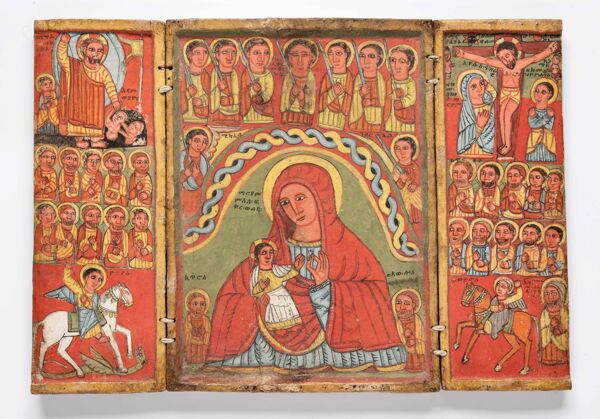
Sacred Images from Ethiopia. Intercultural Workshops and the Cooperation of Artists from Ethiopia, the Mediterranean, the Red Sea and the Indian Ocean

Carolin Schäfer

17 June 2026,18:00 CET (registration see below)

The dissertation, submitted at the Ludwig-Maximilian University Munich, focuses on creating the first coherent museum catalogue of the second largest collection of Ethiopian icons in the world, with 93 objects in the Museum Fünf Kontinente in Munich. Furthermore, it explores the historical, cultural, technical, and theological development of the Ethiopian icon from its earliest known local production in the mid-15th century up to modern pieces. Across five major chapters, stylistic changes are discussed, along with the ways they were driven by shifts within the Christian Empire and by maritime exchanges across the Indian Ocean, the Red Sea, and the Mediterranean. By applying a multidisciplinary approach and consulting additional significant collections, such as those in Addis Ababa and Baltimore, the study establishes a new relative periodisation. This includes improved dating suggestions and introduces previously undefined eras, namely the Solomonic Revival Period, the Transitional Gonderine Period, and the Period of Warriors.

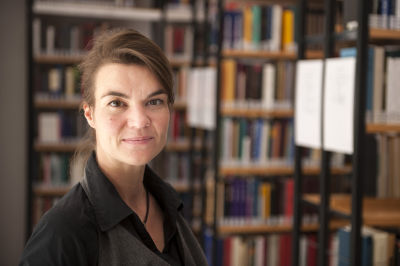
Dr. des. Carolin Schäfer recently defended her dissertation in Late Ancient and Byzantine Studies at the Ludwig-Maximilians-Universität München, Germany. She holds degrees in Art History (M.A., B.A.) and Archaeology (B.A.) and is affiliated with the Textiles in Ethiopian Manuscripts project at the University of Toronto.

(Picture Copyright (C) Museum Fünf Kontinente, Nicolai Kästner)

Registration by by Email

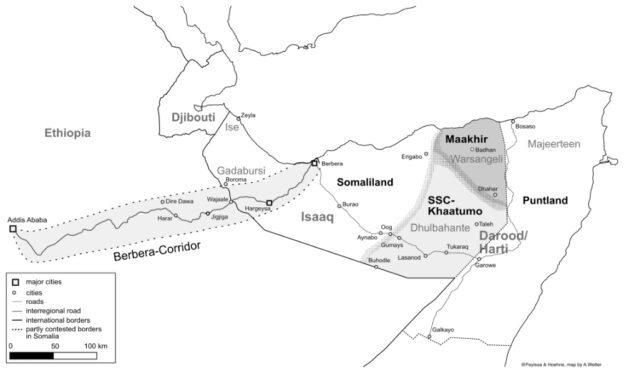
„Unwucht im Clan-System – wie Demokratie und Entwicklung zu wachsender Instabilität in Somaliland geführt haben“

Ein Gastkommentar von Markus Virgil Höhne in der Neuen Zürcher Zeitung.

„Das am Horn von Afrika gelegene Somaliland ist Ende 2025 durch seine Anerkennung als Staat durch Israel bekannt geworden. Das Land erlebt einen starken wirtschaftlichen Aufschwung, doch die Früchte des Wohlstands sind ungleich verteilt, was zu Instabilität führt.“

Link zum Artikel

Der Artikel als PDF

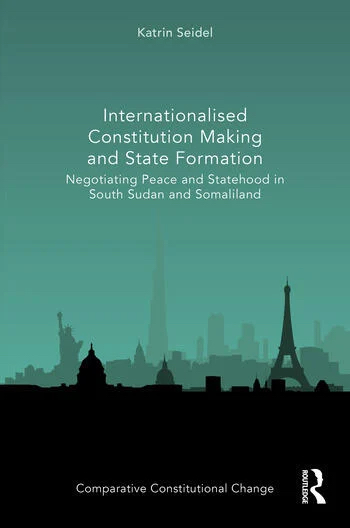
Book presentation: „Internationalised Constitution Making and State Formation. Negotiating Peace and Statehood in South Sudan and Somaliland“

Katrin Seidel

03 July 2025,18:00 CET (registration see below)

„This book presents an in-depth and nuanced interdisciplinary and comparative analysis of (post-)conflict constitution-making in South Sudan and Somaliland, exploring the ways in which the two emerging states negotiate statehood in a globalised world. It critically examines the transfer of international constitution-making models as part of international rule of law promotion frameworks. Specific emphasis is placed on the socio-cultural translation dynamics of these models in conflict settings. The comparative study explores the tensions between state sovereignty and international interventions, examining whether international constitution-making involvement fosters the production of societal consensus or inadvertently impedes efforts to achieve stability and peace. By focusing on constitutional law-making, the book sheds light on how normative ideas are transformed in negotiations and opens up new analytical avenues for re-thinking conventional constitution-making practices. It critically reconsiders the assumption that every emerging state requires a written constitution, alongside the state-centred notion of sovereignty underpinning this paradigm. Additionally, the study addresses the power and knowledge hierarchies inherent in international interventions, providing empirical data from post-conflict African contexts. The book will be of interest to academics, researchers, and policy-makers working in the areas of comparative public law, constitutionalism, sociology of law, anthropology, legal geography, international relations, political science, and African studies.“

Registration by Email

Cattle grazing on the slopes of Mt Marsabit 2010

Grazing Control, Pastoralists and Government ‘showdown’ on Marsabit Mountain in the late colonial era

Hassan Kochore

05 June 2025,18:00 CET (registration see below)

Marsabit Mountain, located in the eponymous county in northern Kenya, offers a key dry season grazing fallback for pastoralists inhabiting the surrounding lowlands as well as for groups from Southern Ethiopia, especially during periods of protracted droughts. In the 1950s, due to increasing numbers of cattle on the mountain, the British colonial administration introduced what it termed, ‘Marsabit Mountain Grazing Control Rules’ (MMGCR). According to the MMGCR, the cattle allowed to graze on the mountain would be branded. This added a new page to the already existing catalogue of rules (such Game and forest rules and so on) targeted  at managing the human population and livestock numbers on the Mountain, and in the township area. The MMGCR particularly targeted cattle numbers, especially those moving between Marsabit and Southern Ethiopia. This led to a protracted struggle between the government officials and the community members over the implementation of the grazing rules. Eventually, a ‘showdown’ with the community that the officials had anticipated materialised. One of the results was that, by official estimations, ’at least half’ of the Boran (one of the agro-pastoralist groups on the mountain) permanently left Marsabit for Southern Ethiopia. Subsequently, the remaining population had to contend with tighter regulations that saw unprecedented levels of contact between the community and the state. Based on Kenya National Archives sources and life history interviews, this presentation (part of a paper in preparation) discusses this critical event. It seeks to make two significant contributions. First, it highlights the specific role of chiefs in the implementation of the MMGCR. Chiefs became important points of contact between the community and the government, managing the demands of the people as well as enforcing government regulations. By critically interrogating this interaction, this paper demonstrates that the nature of the state authority changed significantly. This is down to the fact that chiefs who had previously been, during most of the colonial period, noted to ‘do little good’ to support the administration, became indispensable local level bureaucrats. Secondly, the MMGCR is generally missing from the historiography of the region, eclipsed by the more spectacular decade of secessionist politics and the armed insurgency (The so-called Shifta War) that followed it. This presentation places the MMGCR in the immediate and wider historical context contributing to a closer understanding of colonial environmental ‘conservation’ and the processes of  state (un) making in late colonial northern Kenya and elsewhere in the Horn.

Hassan H. Kochore, earned his PhD from the Max Planck Institute for Social Anthropology and Martin-Luther-University, Halle-Wittenberg . He has has published on the Politics of Decentralisation, Centre-Periphery Relations and Ethnographies of Large-Scale Infrastructures with a regional focus on Kenya and southern Ethiopia. He recently led a Rift Valley Institute project that focused on Decentralisation, Trade and Conflict Dynamics on Kenya’s Borders with Ethiopia and Somalia.

Registration by Email
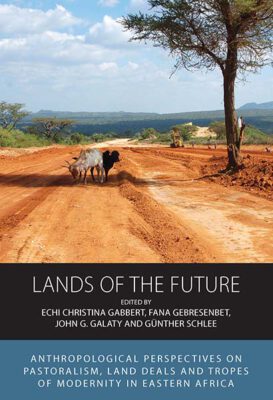
Cover Lands of the Future, 2021

Book presentation: Lands of the Future. Anthropological Perspectives on Pastoralism, Land Deals and Tropes of Modernity in Eastern Africa

Online book presentation with Echi Gabbert, Asebe Regassa and Jonah Wedekind

15. Juni 2022, 18 Uhr, Zoom

About the Book
Rangeland, forests and riverine landscapes of pastoral communities in Eastern Africa are increasingly under threat. Abetted by states who think that outsiders can better use the lands than the people who have lived there for centuries, outside commercial interests have displaced indigenous dwellers from pastoral territories. This volume presents case studies from Eastern Africa, based on long-term field research, that vividly illustrate the struggles and strategies of those who face dispossession and also discredit ideological false modernist tropes like ‘backwardness’ and ‘primitiveness’.

Weiterlesen

Balancing inclusion and exclusion among Somali migrants in Germany

In diesem Artikel diskutieren Markus Höhne und Tabea Scharrer Dynamiken von Inklusion und Exklusion bezüglich somalischer Migrantinnen in Deutschland. Die Autorinnen rücken die Aushandlungen von Migrant*innen ins Zentrum der Analyse und zeigen, wie diese im Prozess der Niederlassung in Deutschland zwischen verschiedenen Normen, individuellen Interessen und unterschiedlichen sozialen Netzwerken manövrieren. Höhne und Scharrer stellen fest, dass entgegen den im öffentlichen Diskurs oft vertretenen Ansichten, ethnische (Selbst-)Identifikation nicht zwangsläufig zu Isolation und Ausschluss aus der deutschen Gesellschaft führt. Vielmehr dienen zum Beispiel formale und informelle somalische Gemeinschaften und Vereine in Deutschland als Brücke, um Kontakt zu deutschen Behörden oder NGOs herzustellen und so Angelegenheiten von gemeinsamem Interesse diskutieren zu können. Gleichzeitig kann Exklusion durch Rassismus zur Abschottung führen, setzt aber auch insbesondere jüngere Somalis unter Druck, Allianzen mit Deutschen zu schmieden, um ihre Situation zu stabilisieren. Auch innerhalb der somalischen Gemeinschaften in Deutschland kommt es zu Ausgrenzungen entlang von Kategorisierungen wie Geschlecht oder Klanzugehörigkeit. Insofern beleuchtet der Artikel die widersprüchlichen und mehrdeutigen Prozesse der Vergesellschaftung im migrantisch geprägten Deutschland der Gegenwart.

Link zum Artikel

Katrin Seidel

Staatenbildung im Südsudan und Somaliland

Ein Interview mit Katrin Seidel zu ihrer Habilitation über Südsudan und Somaliland

Meine Studie untersucht insbesondere das Spannungsfeld zwischen internationalen politischen Interventionen und lokaler Eigenverantwortung. Letztlich geht es um die Aushandlung von Legitimität und Partizipation, von Grundwerten und dem Wesen einer politischen Gemeinschaft

Am 10. Februar 2021 wurde Katrin Seidel von der Juristischen und Wirtschaftswissenschaftlichen Fakultät der Martin-Luther-Universität Halle-Wittenberg habilitiert. Im Anschluss an ihren öffentlichen Vortrag wurde ihr die Venia Legendi für Rechtsethnologie, Rechtssoziologie und Rechtsvergleichung verliehen. Ihre Habilitation schrieb sie zum Thema: “Internationalised Constitution-Making as Tool for Negotiating Statehood and Rule of Law: South Sudan’s and Somaliland’s Constitutional Genesis in the Context of Plural Legal (Dis-) Ordering”

Link zum Interview

Interview: Krieg in Tigray

Der Ethnohistoriker Wolbert Smidt weist in seinem Spiegel-Interview auf kulturelle und demographische Faktoren hin, die bei der Analyse des Krieges in Tigray  wenig Beachtung finden. Dazu gehören die traditionelle Autonomie von Regionen wie Tigray und eine aufgeheizte gesellschaftliche Atmosphäre, in der ein Großteil der sehr jungen Bevölkerung Narrativen zuneigt, die „Schuldige“ benennen.
https://www.spiegel.de/politik/ausland/aethiopien-ethnologe-erklaert-buergerkrieg-a-6f0c8ee5-addc-420f-8d37-cb83c7f47f26

„Äthiopien spricht nicht mehr mit den Äthiopiern“.

Dazu auch der Hinweis auf ein Interview mit Wolbert Smidt im September 2020, in seinem Forschungsgebiet in Tigray. Zur anwachsende politischen Krise sagte er:
https://deutsch-aethiopischer-verein.de/artikel-1/articles/interview-wolber-smidt.htm


Dazu auch ein Artikel über Beschädigungen und Zerstörungen kultureller Denkmäler in Tigray https://news.yahoo.com/no-more-sacred-places-heritage-054549797.html